Over the years, I had always been interested in the Lunar year. More specifically, the moon’s effect on the Earth. It is a known fact that the tides are directly connected to the moon.
I have always sensed that the moon plays an important role in human life. But every time we look at the research, it is either inconclusive or shows little to no significant impact.
As a data scientist, I began to do some research. It was mostly for a research paper, but I was very curious to figure it out.
Here is what I found out.
Full Moon, Crime, and Mental Health
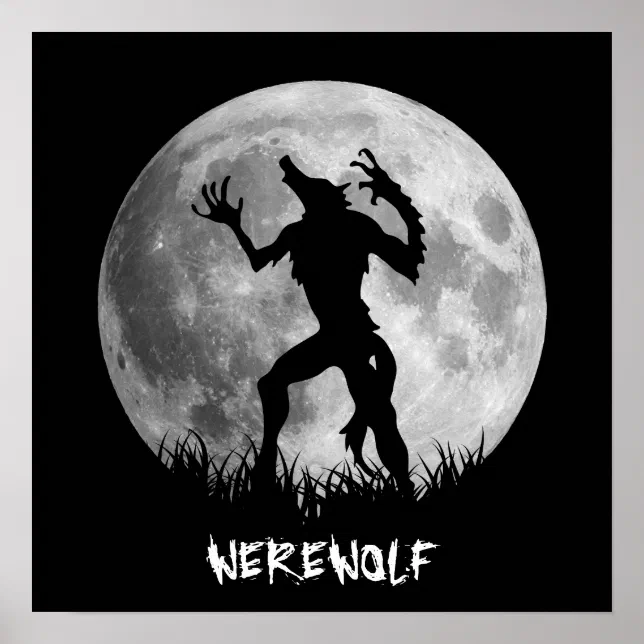
For years, I heard that the full moon brought out the worst in people. Under the moon’s silver light and the night’s darkness, individuals transformed into werewolves.
Once, a friend who was an ER nurse told me that on full-moon nights, the hospital got busier than on other days. The scheduling worked around that as well.
Her comment fell in line with a 2011 study describing how more than 40% of medical staff were convinced that lunar phases affected human behavior.
My research was typical. I started with the following hypothesis:
H_0: The moon has no significant effect on the emergency room visits.
H_1: The moon has a significant effect on the emergency room visits.
In the same 2011 study mentioned above, indicates the data does not support the belief that moon phases affect emergency room visits.
Using the data I was given, the results aligned with my literature review, validating H_0.
Still, I couldn’t get over the fact that a celestial being responsible for tide changes had absolutely no influence on humans.
Perhaps it doesn’t affect the medical field. It could, however, influence other things. How about werewolves?
Ok, maybe not werewolves.
How about other elements? I felt as if I was missing something.
Nonetheless, I had to give it a rest. I let it simmer on the back burner while my analysis had to move on to other weekly demands.
Investigating Other Avenues
Late last year, tired of using Day One as my journal app, I began to draw out my own app. In part, I wanted to analyze myself to better understand what made me happy or sad. Or what made me, me.
Also, I was trying to find communality in my writing. For instance, how much writing do I do about work? Does that make me happy, neutral, or sad? Or, what are the things that I write most about?
I imported all my entries into Reflekt. After doing the initial analysis, I began to expand into other elements of life.
One of those was to correlate the moon phase with my writing mood. What I found shocked me.
What do I mean by writing mood? Let’s talk about how the app analyzes writing.
VADeR
After some research, I decided to use VADeR sentiment analysis.
VADeR is a natural language processing machine learning algorithm. It identifies the sentiment of a given piece of text by breaking it into individual words. Then it assigns a score (-1 to 1) to each word to identify if it is positive or negative. It averages everything out to give a final score.
If your text’s final score is -0.75, it leans more towards sadness or disappointment.
While VADeR is not perfect, I chose to use it because it has already been tested and tried by multiple users.
The model is already trained to understand how certain words can modify the way the text is getting across.
There were two reasons I decided to use a machine learning algorithm to identify how I feel rather than just selecting an option at the beginning of the entry.
First, most of my entries didn’t have an overall sentiment. Over 1,700 entries would be useless data unless I found a workaround.
Second, my writing will tell more about myself than a snapshot of my feelings at a particular moment of the day. Perhaps I was angry about something the previous night, but by the following morning, when I wrote about it, my sentiment may have subsided. The capture of sentiment wouldn’t be as raw as when you are writing.
How the Moon Affects my Mood
After running all of my entries through the text analysis, it scored each entry from -1 (angry) to 1 (ecstatic).
Then I correlated it with the moon phase, and what I found was surprising.
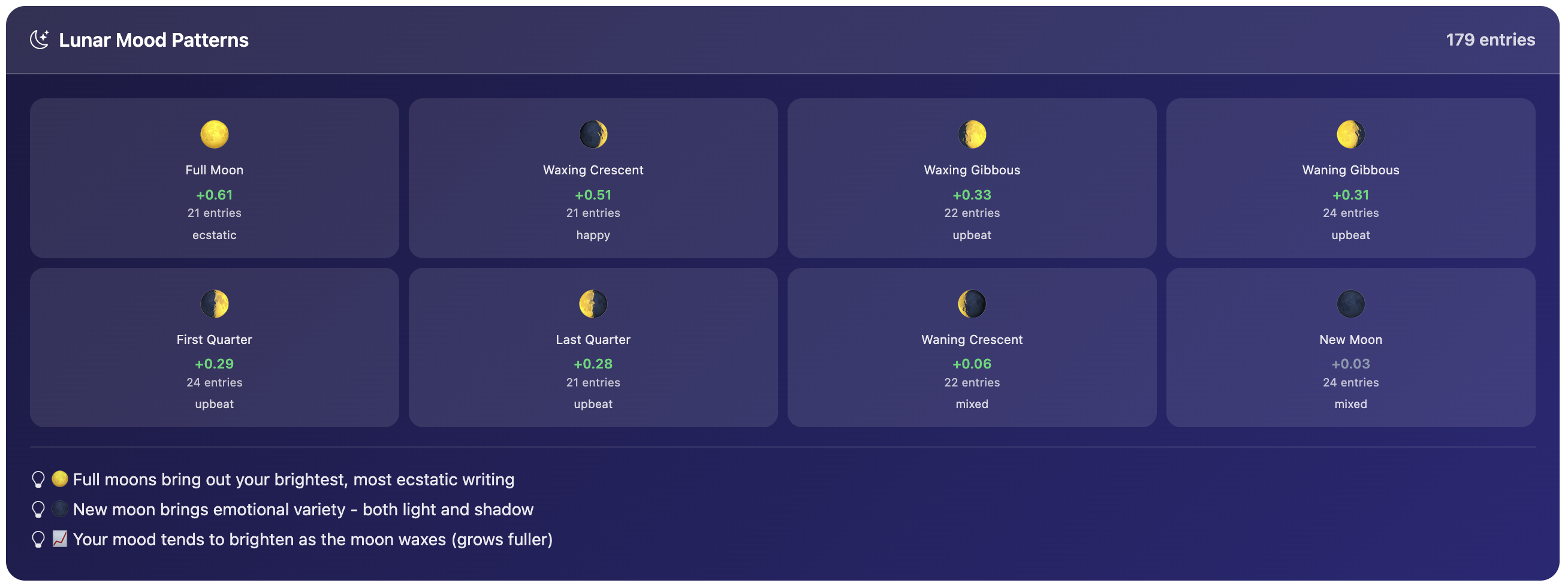
When it is a new moon, my entries tend to be more neutral, closer to 0. In contrast, on a full moon, I am more likely to be happier with a score closer to 1.
I pushed a little further. Instead of 180 days, which is roughly 6 lunar cycles, increase the span to 2 years, or 24 lunar cycles.
The results were very similar.
I must disclose that the data is not 100% reliable. Here is why.
| Year | Entries | Words Written | Avg per Entry |
|---|---|---|---|
| 2025 | 366 | 120,801 | 330 |
| 2024 | 262 | 106,964 | 480 |
| 2023 | 320 | 177,265 | 553 |
In 2025, I had an entry for every day of the year, no skipping. But I only wrote 120k words, or an average of 330 per entry.
Unfortunately, you can see the downward trend in my entries. While I’m doing more, the quantity of words has gone down.
Even after some cleaning up (which I won’t go into the technical details), the trend was fairly similar. New moon time, I have a tendency to be as gloomy as the moon.
Conclusion
Does the moon affect your mood and mental health? I can’t say with certainty that it does. One person alone is not a sample size worth writing a white paper about.
But for me, I know it does. And that is what matters. When I look up at the clear night sky and see the little silver sliver on the right side of the moon, I take preventive measures to avoid feeling depressed.
If you are interested in finding out more about yourself and if the moon plays a part in your emotional state, head over to Reflekt and check it out for yourself.


Comments (0)
No comments yet. Be the first to share your thoughts!
Leave a Comment