Augusta is rich in history — not just the kind told in stories, but the kind built into brick and wood. You feel it as you drive downtown past weathered storefronts, or through the Summerville neighborhood with its oak-lined streets and old verandas.
The century old houses and buildings are majestic. Especially the ones that have been restored.
Often, during my comute to work, as I drive past some of the most iconic places in town, I wonder about the stories behind these old walls—the lives lived inside, the moments etched into their walls.
Unbeknownst to many is that these chronicles have been documented and eternized by the Historic Augusta.
This week, I had the chance to connect with Dr. James Garvey and Dr. Lee Ann Caldwell, the authors of the Augusta, The Book, to grab my very own signed copy.
Augusta, The Book

Celebrating the 50th anniversary of Historic Augusta, Inc, this book is filled with both vintage photos and fresh, beautifully captured views. This book takes you though a visual journey through Augusta’s history—told through its architecture from the 1700s to the late 1900s.
Every purchase helps Historic Augusta continue its work preserving the city most significant buildings and landmarks in Richmond County.
If you are fascinated by Augusta’s history as I am, you will love this book. It makes a perfect coffee table piece. You can purchase your own copy at the History Augusta website. Again the preceeds go 100% to the entity.
Meet the Authors
During the book signing at Barnes and Noble earlier this week, I had a chance to chat with the authors.
Dr. Lee Ann Caldwell, the Historian
Dr. Lee Ann Caldwell is the Director of the Augusta University Center for the Study of Georgia History. Over her career, Dr. Caldwell published textbooks on Georgia history, as well as scholarly journals such as Journal of American History, the Journal of Southern History, among others.
She serves as a member of the executive boards of Historic Augusta, the Augusta Historical Society, and many others. She has consulted and appeared in several documentaries and served two terms as the president of the Georgia Association of Historians. In addition to her accomplished career, she has written articles for the Augusta Magazine.
Dr. James Garvey
Dr. James Garvey taught English and Journalism for nearly 40 years. He has written extensively about local history. He was also part of the Augusta University Library’s Holocaust Lecture Series.
In addition to lecturing, he was also a coach writer for the Augusta Chronicle and has written multiple articles for the Augusta Magazine.
The Buildings of Augusta
During our conversation, we talked about the historical buildings spread throughout the city. The oldest. The most prominent. The confusion of the Ezekiel Harris House, and so on. But there is so much more history in this city than is covered in the book. Augusta has so many more houses that depict the beautiful architecture of the early 1900s.
Sadly, a lot of those houses and buildings are not in good shape. Many colonial houses in downtown have been purchased by slum lords who have divided them into multiple units. Over the years, they have been poorly patched and have accrued deferred maintenance. Our conversation landed on the most prominent decayed historical building in town—The Lamar Building.
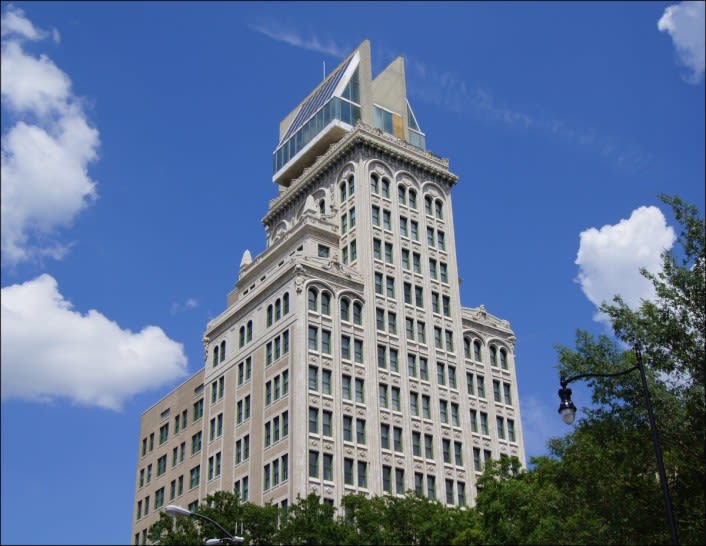 Source: Newmark
Nestled in the heart of downtown, the Lamar Building was once Augusta’s tallest and most majestic landmark — a proud silhouette against the skyline. Today, it tells a different story: shattered windows, graffiti-covered walls, and years of silence behind its doors.
Built in the early 1900s, the skyscraper survived the devastating 1916 fire and reopened in 1918. In 1973, a very prominent figure purchased it—State Senator Eugene Holley. But when falling into financial crisis, he was forced to sell it. Since then, the building has passed through many hands, each with big dreams that never quite materialized. It was recently sold again to Lockwood and Mead, a Connecticut-based development firm.
The new hopeful owners have announced plans to transform it into a mixed-use space. For now, however, those plans remain just that: plans.
Dr. Garvey admits he’s not overly hopeful about the skyscraper’s future. This isn’t the first time promises of restoration materialized. Historic preservation is no easy task — it demands vision, patience, and deep financial commitment. The Lamar will test all three.
Conclusion
If you love history — especially the reading about the stories and architectures — Augusta, The Book is a must-have. It’s more than just a collection of photographs; it captures the architecture that has shaped generations.
Every purchase supports Historic Augusta’s mission to protect and preserve the landmarks that make our community unique. Whether you’re a lifelong Augustan or a newcomer eager to learn the stories behind our streets, this book is a reminder of why preserving our past matters.










Comments (0)
No comments yet. Be the first to share your thoughts!
Leave a Comment