Augusta is rich in history. From abandoned buildings to the last remaining permanent structure built by the Confederates, these streets have story to tell.
Drive down Reynolds Street toward the river, past the Augusta Museum of History, and you’ll pass it without meaning to: a long, low, red-brick building sitting behind chain-link on some of the most valuable land in the city. Boarded windows. Weeds in the lot. A stone’s throw from the Riverwalk and the Savannah River, and empty as a Sunday morning.
The old depot has generated an astonishing amount of noise — decades of grand plans, tens of millions of dollars promised, renderings unveiled to applause, and, so far, absolutely nothing built. Here’s the story of how Augusta’s most promising empty lot got that way, and why it’s still sitting there.
Southern Railway Freight Depot
Often confused with Union Station, the old Southern Railway freight depot used to be a working warehouse where goods moved on and off trains.
The freight depot’s job was humbler and, in its day, more constant: it was where Augusta’s cotton, cargo, and commerce met the rails.
The site’s railroad roots run deep. The land was used by the South Carolina Railroad going back to the 1850s, and the long freight shed running along Reynolds Street was built in the early 1900s once the Southern Railway had absorbed the line.
So it isn’t a single-date building so much as a layered one — mid-19th-century bones with an early-20th-century body. You’ll sometimes see the property listed as 511 Reynolds Street; it spans the block around Reynolds and 5th/6th, at the east end of the Riverwalk.
Why the Railroad was so Important Back in the Day
For its first century, Augusta was a cotton town that moved its wealth by water. Bales came down to the riverfront and floated to Savannah on steamboats — slow, expensive, and at the mercy of the river.
Then, in 1833, everything changed. The South Carolina Railroad reached Hamburg, just across the water from our beloved city, and was briefly the longest railway in the world.
Georgia’s leaders, unwilling to hand their cotton trade to South Carolina, chartered the Georgia Railroad and Banking Company; by 1835 the rails had reached Augusta and pushed west along a route trains still use today.
Reynolds Street became the spine of all that commerce — “Cotton Row,” lined with warehouses and served by riverfront rail sidings. The freight depot sat right in the thick of it, a place where the region’s most important crop was loaded, unloaded, weighed, and shipped. For generations, this unglamorous brick building was part of the machinery that made Augusta rich.
And then the machinery stopped. Freight and passenger rail wound down through the mid-20th century, and the depot has sat essentially unused since 1966 — roughly sixty years of emptiness, most of it spent as an overflow parking lot for the Riverwalk.
The Cautionary Tale Next Door: Union Station
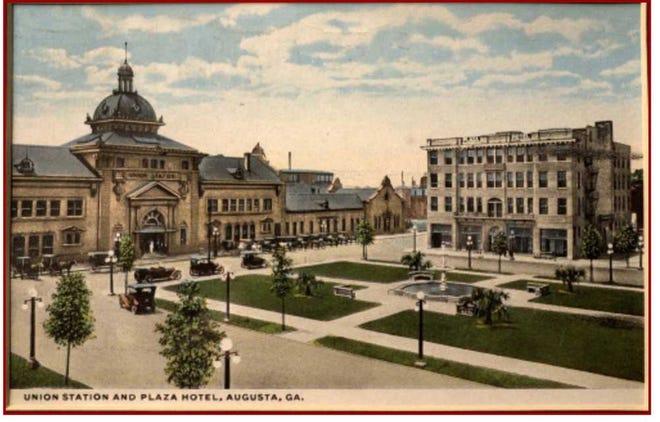
Union Station was the real showpiece — a Spanish Renaissance passenger terminal that opened in 1903 at Barrett Plaza on 8th Street, designed by architect Frank Milburn, complete with marble-lined palm courts built to impress the wealthy Northern tourists who wintered here. It served half a dozen railroads and trains with names like the Augusta Special and the Palmetto.
It closed in 1968 and in 1972, for some wild reason, it was demolished.
Today a post office sits on the spot. Almost nothing of the grand old station survives except its salvaged dome cupola, now sitting on a lawn over on Telfair Street, and a railroad gateway arch preserved near the arena — orphaned pieces of a building the city decided it didn’t need.
That’s the ghost hanging over every conversation about the freight depot: Augusta has torn down its railroad heritage before, and regretted it.
And that’s why the Freight Depot has been the center of some discussions. Locals have fought to save this historical building.
The Redevelopment Saga
Here’s where the story turns from history into a slow-motion civic soap opera.
The depot site is roughly six acres and it might as well be riverfront. On paper, it’s a developer’s dream — river views, Riverwalk access, walking distance to downtown. In practice, it has broken nearly everyone who’s tried.
An early effort in the 2000s reportedly collapsed amid an ugly episode in which sitting commissioners were said to have pressured a would-be investor to also build a hotel and condos and kick in donations to their pet charities. The investor walked. That set the tone.
The big one came in 2017, when the Augusta Commission voted unanimously to partner with the Downtown Development Authority and Birmingham-based developer BLOC Global Group on a roughly $93.6 million mixed-use project branded “Riverfront at the Depot.”
The vision was genuinely exciting: renovate the historic depot itself into a Ponce City Market-style retail and food hall, and surround it with about 140 apartments, 100,000 square feet of Class-A office space, parking decks, retail, and a community green. Boosters projected around 800 jobs.
In August 2018, the Commission committed $14 million in public money. That October, the design was unveiled to real fanfare. Through 2019, the momentum looked real — letters of intent from retailers, whispers of an out-of-state brewery, a hoped-for groundbreaking that fall.
Then, in February 2020, it died. BLOC Global terminated the project, and the Downtown Development Authority voted to return the developer’s $100,000 in earnest money. A plan discussed for more than four years simply evaporated — and it happened, as it turned out, just weeks before the pandemic would have frozen everything anyway.
Why It Keeps Failing
Peel back the different collapses and the same culprits keep showing up.
For a long time, the parking lot was a big issue. The adjacent office building — that Unisys once occupied — helds a long-term, essentially perpetual arrangement obligating the city to provide it around 500 parking spaces on or near the depot site. Develop the depot, and those spaces vanish.
No one ever locked down a replacement-parking plan, and as one commissioner bluntly put it, you can’t make a deal on property where there’s already a deal in place. When the BLOC project fell apart, that unresolved parking obligation was the single most-cited reason.
Behind it sat the ordinary killers of big projects: a financing gap the developer never closed (BLOC needed something like $79 million in private money on top of the city’s $14 million), a governance history that scared off investors, and a running tension over the old building itself — some see a historic structure worth saving, others see a run-down warehouse standing in the way of a parking deck.
In 2021, voters approved SPLOST 8 with about $14 million earmarked around the depot — not for the grand vision, but essentially for a parking garage that might satisfy the Unisys obligation and finally clear the way for someone to develop the site. Around the same time, a local editorial argued the city should just tear the old depot down and be done with it.
Where Things Stand Today
As of 2026, the honest answer is: nothing.
No new developer has been announced. No revived mixed-use plan is on the table. The most recent downtown news around Reynolds Street concerns general infrastructure work and a couple of new parking lots that opened near James Brown Boulevard — part of broader downtown construction, not the depot. The building still stands, still boarded, still waiting, on a riverfront that keeps getting talked about and never quite gets going.
It’s a strange kind of limbo. The land is too valuable to ignore and too tangled to build on. The building is too historic for some to demolish and too derelict for others to defend. And so it sits — a hundred-and-fifty-year-old survivor of Augusta’s railroad age, boarded up against a river that once made this exact spot the busiest corner in town.
Maybe the next plan will be the one that sticks. Augusta has been saying that for twenty years.









Comments (0)
No comments yet. Be the first to share your thoughts!
Leave a Comment